





No results available

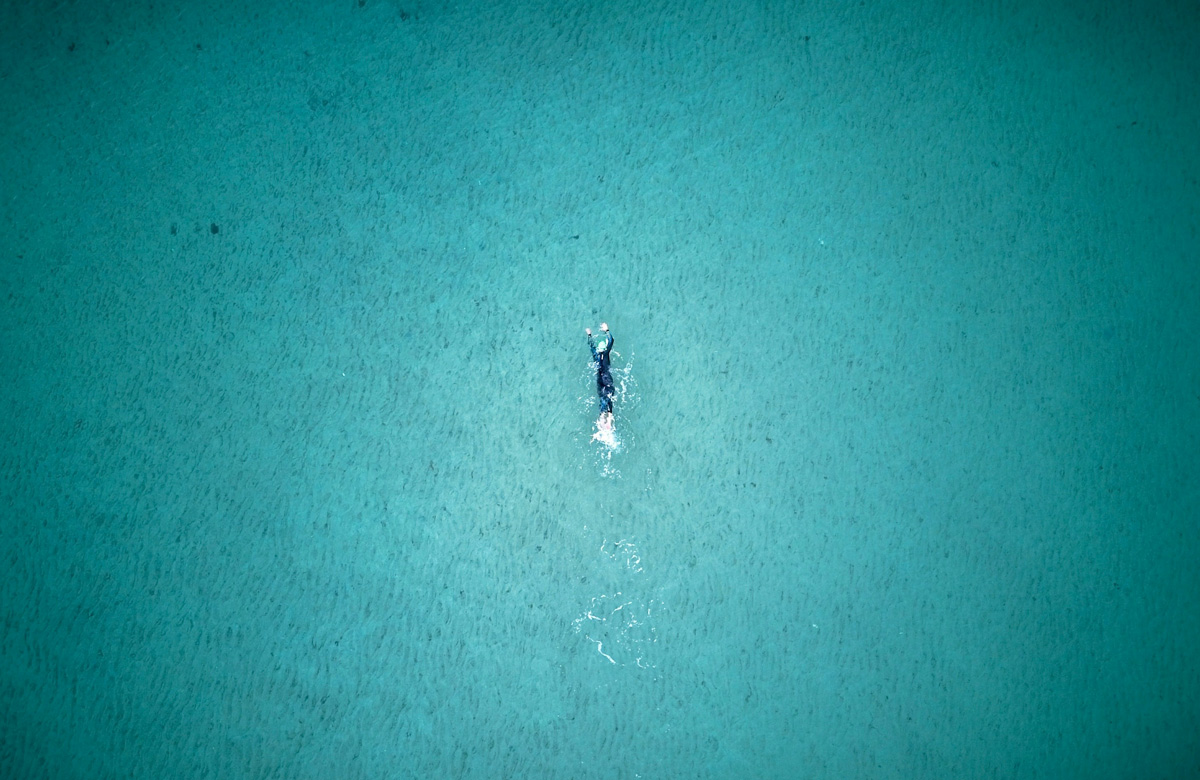
After months of writing, listening and thinking about sharks, Andre Slade shares his personal view on NSW’s expanding drone program, the questions still unanswered, and what it could mean for our relationship with the ocean.

By Andre Slade – Owner, Ocean Swims and OceanFit
Over the past six months I’ve probably thought, written and talked about sharks more than I have at any other point in my life. Between the incidents in NSW, the rapid expansion of the shark drone program, the editorials I’ve written here and the hundreds of responses to the Ocean Swims Shark Sentiment Survey, one question has kept coming back to me, and being asked of me: what do I actually think about it all?
I’ve been reluctant to answer that too directly, partly because I’m still working it out myself. I don’t have inside information from the NSW Government or Surf Life Saving NSW. What I do have is three decades around lifesaving and water safety, two decades in ocean swimming, the experience of teaching more than 5,000 people, and a professional career across marketing, communications and customer experience. That probably explains why I look at this not only through the lens of whether the technology works, but how people understand it, experience it and ultimately respond to it.
And I think this summer is going to test all of that in a way we haven’t experienced before. Whatever the underlying population data eventually tells us, the practical reality for ocean users is that we are detecting and encountering sharks more often, particularly around Sydney and further north through regional NSW. More tagged sharks are being detected, surfers and swimmers are reporting more encounters, and drones are showing us just how often sharks are moving through the same water we use. At the same time, we are about to watch an unprecedented shark surveillance program meet its first proper summer, and I suspect that will create a very different experience on beaches than many people are expecting.
My feeling is that the drones will find a lot of sharks and beaches will be cleared regularly, including at times for sharks that ultimately posed little credible threat. Initially, I think most people will accept that caution because nobody wants another serious shark incident and, when technology exists that might help prevent one, it is emotionally and politically very difficult to argue that we shouldn’t use it. But if closures and alerts become a normal part of summer, I also think fatigue will start to set in. Regular ocean users may begin treating warnings differently, some alerts will inevitably be ignored, and the system will be tested by the uncomfortable reality that no amount of surveillance can completely remove shark risk.
That becomes even more complicated if, despite all the additional surveillance and investment, there is another serious or fatal incident. At that point, I suspect the public conversation could move very quickly from whether drones are working to whether governments should be doing something stronger. I’m not suggesting I know what that response would be, but it is not difficult to imagine pressure growing for some form of lethal shark control if people come to believe that unprecedented surveillance still isn’t enough. Politically, that would be a very difficult conversation to avoid.
At the same time, I understand exactly why all of this is happening. Nobody wants to see another person attacked by a shark and I’m certainly not standing on the beach arguing that the drones should be taken away. If there is a chance that one of them spots a genuinely dangerous shark approaching a group of swimmers and gives them enough warning to get out of the water, who wants to be the person arguing we shouldn’t have had it there? Certainly not me. That is what makes this conversation so difficult. We can question the system, worry about unintended consequences and still be grateful that people are trying to prevent another tragedy. Those positions aren’t contradictory, and I suspect that tension is exactly where many ocean swimmers currently sit.
This is unprecedented action, introduced quickly and with the best of intentions, but we don’t yet know what happens when it meets a busy Australian summer, thousands of beach users and the messy reality of human behaviour. We’re about to find out.
I’m also conscious that this is an emotionally charged subject. Someone who has had a close encounter, lost someone, is naturally risk-averse, strongly prioritises the animal and environment, or depends on beach use for their livelihood will all come at it from very different places. None of those perspectives is automatically wrong, but they inevitably shape how we interpret the same information.
More: Sharks, risk, and why this conversation matters
My own thoughts start long before the current drone program, back when I began teaching ocean swimming at Bondi in 2009. Through spring and summer I’d often spend five or six mornings a week on the beach, yet apart from the odd wobbegong around places like Clovelly, I can’t remember ever seeing a shark while swimming in Sydney.
That doesn’t mean they weren’t there. Of course they were. What interests me looking back is how little that fact occupied our minds. I remember arriving for a class one morning after somebody said they’d seen a shark. There was a bit of standing around and looking out to sea, but nobody suggested we shouldn’t swim. We eventually stopped looking, walked into the water and got on with the class. It didn’t feel brave or reckless. It just felt normal.
In fact, sharks weren’t even the fear I heard about most often from beginners. Seaweed, deep water and waves were all more common. When sharks came up, I tried to put the risk into perspective and move the conversation back towards understanding the ocean rather than fearing it.
Around the same time, technology started giving us a completely new view of the ocean. I was taking an early GoPro into the water and later paid someone with an early drone to film the 2014 Coogee Island Challenge. I loved what those images did because they showed people the beauty of ocean swimming in a way that had previously been difficult to explain.
Looking back now, I wonder whether we underestimated the other side. As cameras and drones became commonplace, we started seeing things we had rarely seen before, including sharks, and social media rewarded the footage that stopped people scrolling. It wasn’t necessarily that the sharks had suddenly arrived. We had simply become much better at seeing them.
I started noticing the effect on newcomers too. People who had never seen a shark were arriving with a mental library of footage from the very beaches where I was asking them to swim. Their understanding of the risk was increasingly being formed before they ever reached me.
There have always been shark incidents, some horrific and some frighteningly close to places where many of us swim. When they happened, people stayed out of the water and conversations revolved around what had happened, but then time passed, and eventually life around the ocean found its rhythm again.
I’m not sure that happens in quite the same way anymore. Perhaps it’s because footage now follows so many encounters. Perhaps social media means an incident keeps reappearing for weeks. Perhaps recent incidents have happened at beaches that feel like our front doorstep. Or perhaps there genuinely is a change happening in shark activity that regular ocean users are noticing before the broader data can fully explain it.
More: Holding perspective when the ocean feels different
What does feel different is how often sharks now occupy our minds. Our Shark Sentiment Survey challenged some of my assumptions because respondents pointed strongly towards the incidents themselves as the reason they felt differently. Yet many also valued drone surveillance while thinking about sharks more often. Perhaps the incidents changed the baseline, while the stream of alerts, footage and closures makes it harder for that baseline to settle again.
More: Safer, But Thinking About Sharks More Than Ever
That brings me to the current drone program. When the NSW Government committed unprecedented funding to dramatically expand aerial shark surveillance, I understood the appeal. After a heightened period of incidents, there was enormous public and political pressure to do something, and drones offer an apparently simple response. They can see what we cannot see from the water and potentially warn people when an animal of concern is nearby.
My first thought, though, wasn’t whether the drones would find sharks. I knew they would. My first thought was what would happen once we started looking for sharks at this scale, every day, across heavily used beaches. What would happen to the way people felt about entering the ocean when a surveillance system designed specifically to detect sharks was operating above them? And what would happen when those sharks were found, beaches were cleared, alerts issued and footage started circulating?
More: Be careful what you wish for, eyes in the sky
The more I’ve watched the rollout, the more I’ve realised my concern isn’t one particular flaw. It’s that some basic questions still don’t have simple answers for the people using the water. If I turn up at a beach and see a shark drone overhead, what exactly does that mean? Is somebody continuously watching the area I’m swimming in? If the pilot sees a shark, how will I know? What happens when weather prevents it flying? And if there is no drone overhead, should I interpret that differently? A public safety system should be understandable to the public, yet I’m not sure a swimmer can currently explain what a “drone beach” actually promises.
Then there is the harder question of what constitutes enough risk to clear the water. Is it species, size, behaviour, distance from people, or some combination of those things? Would the same shark produce the same response at different beaches and under different operators?
There is also a very human element here, because the drone doesn’t make the decision. A person looking at a screen does. The system involves trained professional and volunteer operators, and I’m not questioning their commitment, but anyone who has spent enough time around lifesaving knows experience changes how people interpret risk. We’ve all seen the whistle come out a little earlier with someone less experienced, while an old hand with years of local knowledge might manage the same situation calmly.
With sharks, those calls carry a completely different weight. If I were behind the controls and saw a large shark near swimmers, I’d be very conscious of what could happen if I chose not to warn them. Even if an operator is legally protected, there is still the human consequence of being the person who got it wrong, so I suspect almost anyone placed in that position would err on the side of abundant caution. I can hardly blame them.
The problem is that the safest personal decision for the operator may also be the most disruptive decision for everybody else. There is little downside to clearing a beach unnecessarily, while failing to clear it could carry enormous emotional and professional consequences. That is one reason I suspect we may see beaches cleared far more often than people currently expect.
Initially, that may feel reassuring. A shark is spotted, the water is cleared, people wait and perhaps footage appears online later. The system appears to have worked. But what happens when it happens again and again? What happens to the swimmer who has been cleared from the water half a dozen times and later discovers that several of those sharks were species they would never previously have considered a reason to stop swimming? What happens when surfers sit on the sand watching good waves go unridden because a shark was seen somewhere along the beach?
This is where I think alert and closure fatigue could become one of the biggest challenges of the program. Public safety systems rely not only on issuing warnings but on people continuing to take those warnings seriously. If every alert is interpreted as an imminent threat, yet people repeatedly experience alerts without anything happening, the natural human response may eventually be to downgrade them.
Regular ocean users may start developing their own hierarchy. What species was it? How big? How far away? Which direction was it travelling? Was it behaving unusually? Was it actually anywhere near us? In some ways that could be a more informed response, but it also creates another problem. Once people begin deciding which official warnings matter and which don’t, what happens when the warning they dismiss is the one they should have listened to? I don’t think we’ve really begun talking about that yet.
Perhaps abundant caution is exactly what the public wants, but if it is, we should be honest about the trade-off. It also raises a bigger question: should every person in the ocean be treated exactly the same way? Someone visiting the beach with their family may quite reasonably want to leave immediately after an alert, while an experienced ocean swimmer who trains offshore several times a week may receive exactly the same information and decide they are comfortable continuing.
Are drones there to give ocean users better information so they can make better decisions, or are they there to make the decision for everyone in the water? Those are two very different models of public safety.
More: Why generic shark messaging isn’t working for ocean swimmers
There is also the slightly strange situation where a beach may have a shark drone overhead without a lifeguard or lifesaver patrol underneath it. I understand the logic of putting extra eyes over an unpatrolled beach, but if sophisticated technology is watching for one particular hazard while nobody is there to manage all the others, what does “protected” actually mean?
And could that sense of protection create its own problem? I’m already noticing some swimmers respond to drone alerts with an almost outsized sense of gratitude that someone has spotted a shark and “kept them safe”, even though we can’t possibly know whether that shark represented any meaningful threat in the first place.
People naturally place extra weight on information that comes from an authority, particularly when those around them accept the same interpretation. Tell a beach full of people they were just protected from danger and many will understandably come away believing they were in danger. Over time, I wonder whether we start outsourcing our own assessment of ocean risk to the system above us rather than making sense of the information ourselves.
A drone alert may be genuinely useful information, but it isn’t necessarily evidence that somebody was about to be attacked, just as the absence of an alert doesn’t mean there is no shark nearby. If we’re going to understand the psychology of surveillance, reassurance deserves just as much attention as fear because both can quietly change the decisions we make in the ocean.
Zooming out a little, there’s also the broader water-safety picture to consider. Hundreds of Australians drown every year, often without anything approaching the public attention generated by a shark sighting. I’m not suggesting shark safety shouldn’t be funded, but when tens of millions of dollars and enormous political and organisational energy can suddenly be mobilised around one risk, it is fair to ask how shark surveillance fits alongside lifeguard coverage, swimming education, rip current awareness and rescue capability.
More: Australians are drowning, spread the word
The ripple effects also reach beyond the swimmer. If drone surveillance becomes expected at popular beaches, will ocean swims, triathlons, surf carnivals or nippers need it too? Will insurers or councils require it, and who pays if it becomes part of the expected standard of care? And what happens when the technology isn’t available, a drone runs out of battery, weather grounds it or there’s a technical failure? Does an event get delayed, shortened or cancelled because a safety measure that didn’t previously exist has suddenly become something people feel they can’t proceed without?
More: Supporting event organisers when tough calls have to be made
Then there is the footage itself. We now have organisations involved in the program producing an extraordinary stream of shark imagery. Some has clear operational value, but some is also being shared through social media, alongside footage from private operators, where a shark swimming harmlessly beneath surfers can quickly become dramatic content suggesting somebody narrowly escaped an attack.
The footage hasn’t changed; the story has.
I’m also not really sure what motivates some private drone operators who spend their time looking for sharks, and I think it’s a fair question to ask. If the footage they captured could no longer be shared on their social media channels, would they still provide the same service? Maybe they would, and perhaps their motivation is entirely about helping people at the beach. But when shark imagery is also highly engaging content, it’s reasonable to wonder where public service ends and the incentive to generate attention begins.
I’d also be interested to know whether those sharing the footage genuinely believe it has a positive outcome for beach users. Does it help people understand the ocean better, or simply make the risk feel more immediate? If the intention is educational, then how the imagery is framed becomes just as important as sharing it.
I understand why organisations want to show what publicly funded programs are finding, but who is considering the cumulative effect? We have invested heavily in finding sharks without an equally visible public campaign explaining what a sighting means, the limitations of drones, what people should do when alerted, and why the presence of a shark does not automatically mean an attack was about to occur.
More: Be Careful What You Wish For: Six Months On
Then there is perhaps the most uncomfortable question of all. We can spend tens of millions of dollars, put drones above beaches, tag sharks, issue alerts, clear water and improve communication, and there could still be another serious shark incident. There could still be a fatality.
That isn’t an argument against trying to make people safer. It is simply the reality of managing a very low-frequency but potentially catastrophic risk in a wild environment. No system can reduce that risk to zero, but the more surveillance is presented as something keeping people safe, the greater the expectation may become that it should prevent an attack.
If another serious incident occurs despite all this investment, I suspect the public response will be to demand that governments do more. Once surveillance, detection and beach closures are already operating at scale, that could quickly reopen the conversation around stronger intervention, including some form of lethal shark control. I’m not suggesting that is what should happen, but politically it isn’t difficult to imagine how we get there.
That brings me back to the part of the program that concerns me most. It isn’t the drone itself. It’s that we’ve moved from proving drones are very good at finding sharks to building a public safety system around them before everything surrounding that technology was equally ready.
Beach users should understand what a drone means, operators should work from consistent thresholds, communication should be clear, and people should understand the difference between detecting a shark and detecting a credible threat. Just as importantly, success should be measured by more than how many sharks are spotted or how many beaches are cleared. We should also be looking at public confidence, participation, behaviour and whether repeated alerts are actually helping people make better decisions.
Summer will be the first real test. If frequent sightings lead to repeated closures, rising anxiety, people ignoring alerts or new costs for events and businesses, we need to be willing to adjust the system rather than assuming more surveillance is always the answer.
That is why my position is more complicated than simply being for or against it. I am not anti-drone or anti-investment in beach safety, and I don’t want to see another person seriously injured or killed by a shark. If better surveillance can prevent that, I want it to succeed.
But I also don’t think anyone really knows what happens next.
For most of my life around the ocean, sharks were something I knew were there without needing to think about them every time I entered the water. I respected the possibility, made sensible decisions and got on with swimming. Helping thousands of swimmers reach that same place of informed confidence has been one of the most rewarding parts of my work.
Maybe better surveillance will strengthen that relationship rather than weaken it. Maybe this is simply an uncomfortable transition while we learn to live with far more information about an environment that was always more active beneath the surface than we realised. I genuinely hope so.
But I suspect this summer will tell us a lot. We are going to see more sharks because we are looking harder for them, we are going to receive more information about where they are, and we are going to have to work out what level of shark risk we are actually prepared to live with if we want to continue enjoying the ocean.
As we put more eyes in the sky this summer, I hope we also spend a little more time looking at what is happening down on the beach, in our swim groups, around our events and, perhaps most importantly, in our own heads. Because making the ocean safer is enormously important, but so is making sure people still want to swim in it.




No results available



Copyright © 1999-2026 oceanswims.com. All rights reserved.
‘OCEANFIT is a registered trademark of OceanFit Pty Ltd.


Swimrun Australia: Sydney North