









If you’ve ever watched a game of water polo, you might have noticed the players seem to swim differently from pool swimmers. Their heads stay above the water, they can see where they’re going, and they appear ready to change direction or launch into action at any moment.
Known as polo freestyle or simply polo, this technique is a valuable skill not only for water polo players but also for ocean swimmers. Learning how to swim polo can improve your sighting, awareness, and ability to navigate busy race starts or rough conditions.
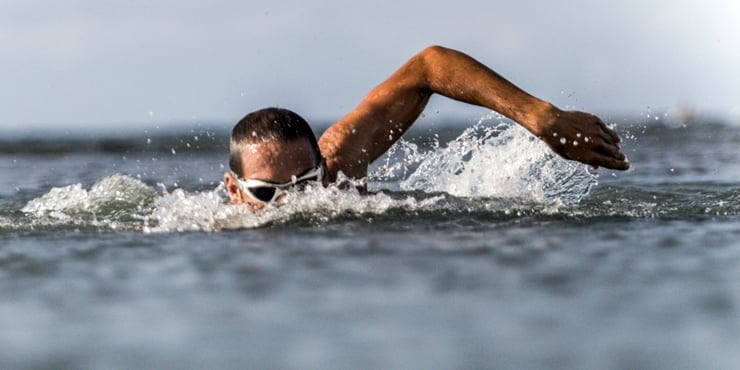
Polo is a variation of freestyle where you keep your head raised above the water while swimming. This allows you to continuously look forward and keep track of buoys, waves, and other swimmers.
Unlike traditional freestyle, where the body remains long and streamlined with the face mostly in the water, polo sacrifices some efficiency in exchange for visibility and control.
While you wouldn’t swim an entire ocean race using polo freestyle, it can be an incredibly useful skill.
Benefits include:
Many experienced ocean swimmers naturally switch into a short burst of polo when approaching a turning buoy, navigating through a pack, or swimming through surf.
One of the biggest mistakes beginners make is lifting their entire head and chest out of the water.
Instead:
The goal is to minimise drag while still maintaining visibility.
When you lift your head, your legs naturally want to sink.
To counter this:
A stronger kick helps keep your hips high and prevents excessive drag.
Polo swimming often uses a slightly shorter and quicker stroke than traditional freestyle. Focus on:
This helps maintain momentum while your head is elevated.
Your core acts as the bridge between your upper and lower body. Think about:
A strong core makes polo swimming significantly easier and more efficient.
Try this during your next pool session:
6 x 25m Polo
As you improve, progress to:
4 x 50m
This teaches you to transition smoothly between the two techniques, which you will do in the open water.
Polo is best used in short bursts rather than continuously.
Good times to use it include:
A few strokes of polo swimming can often save you from swimming off course and adding unnecessary distance to your race.

The higher your head comes out of the water, the more your legs sink.
Keep your eyes just above the surface rather than trying to lift your entire face clear.
Without a strong kick, your body position quickly deteriorates.
Which means one thing, your legs sink, and swimming becomes harder because of the drag.
Polo is useful but inefficient over long distances. Use it strategically rather than as your default stroke.
Focus on a point roughly 10-20 metres in front of you rather than trying to see the entire course.
Polo is a simple skill that can make a big difference in the ocean. By learning to swim freestyle with your head up, you’ll improve your sighting, awareness, and ability to handle crowded or challenging conditions.
You don’t need to become a water polo player to benefit from it. Adding a few polo drills to your training each week can help you stay on course, navigate more confidently, and become a more adaptable ocean swimmer when race day arrives.










Swimrun Australia: Sydney North