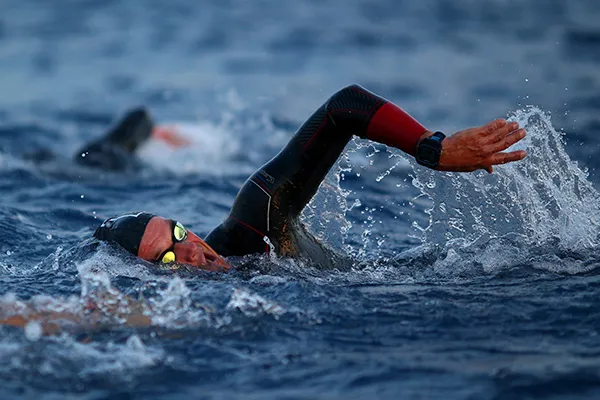
If you’ve spent years breathing to one side in freestyle, you’re not alone. Most swimmers have a preferred breathing side; it feels more natural, comfortable, and efficient. But while breathing to your dominant side works fine for short pool sets or calm conditions, it can become a liability in open water where chop, sun glare, or waves can come from any direction.
That’s where bilateral breathing, alternating sides, usually every three strokes, comes in. It’s not just a technical trick; it’s a skill that can make you a more balanced, adaptable, and efficient swimmer.
Why bother with bilateral breathing?
1. Balance and symmetry
Breathing to one side can create subtle imbalances in your stroke. You might notice one arm crossing over the midline, your body rolling unevenly, or even your legs drifting off course. Over time, these habits can cause shoulder niggles or drag you slightly off line in open water. Switching to bilateral breathing helps even things out. You’ll develop a smoother rotation on both sides, better alignment through your core, and a more consistent rhythm across your stroke.
2. Better navigation and awareness
In open water, conditions change constantly. Swells might come from the right, chop from the left, and sun glare can blind you on your breathing side. Being able to comfortably breathe both ways lets you adapt, sight on one side, breathe away from waves on the other, and keep an eye on competitors or landmarks no matter where they are.
3. Improved oxygen control
Breathing every three strokes forces you to control your exhalation and timing underwater. That can improve your CO₂ tolerance and help develop a more relaxed, efficient rhythm. You’re less likely to over-breathe, which can help maintain a steadier heart rate over long swims.
4. Enjoy the view
One of the underrated perks of bilateral breathing is being able to take in the scenery. If you can switch sides, you’ll always have the option to breathe toward the coastline rather than out to sea. On a coastal swim, that means glimpsing beaches, cliffs, and headlands you’d otherwise miss – and it can make every breath feel like part of the experience.
How to make the switch
Like any skill, it takes time and patience. The good news? You don’t have to overhaul your whole stroke overnight.
Start small in the pool
Begin by adding a few bilateral lengths to your warm-up or drills. Try breathing every three strokes for 25 metres, then return to your usual pattern. Gradually increase the distance as it feels more natural.
Use breathing sets
Try sets like:
- 4 × 100m: breathe every 3 strokes
- 4 × 100m: breathe every 5 strokes
- 4 × 100m: alternate 3 / 2 / 3 / 2 breathing pattern
This not only builds comfort but also teaches flexibility in your breathing rhythm, handy when you hit choppy water or find yourself surrounded by other swimmers.
Focus on relaxation
Many swimmers struggle because they hold their breath underwater. Make sure you’re exhaling steadily through your nose or mouth before turning to breathe. When it’s time to inhale, you’ll feel calm and ready, not gasping for air.
Check your alignment
Ask a coach or training buddy to film you. When you breathe to your non-dominant side, watch for over-rotation, dropped elbows, or a wobbly kick. Small technical fixes, like keeping one goggle in the water or rotating through the core, can make breathing feel smoother and more natural.
Taking it to the ocean
Once you’re comfortable in the pool, practice bilateral breathing in open water where it really counts. Start in calm conditions, then test it in different seas. You’ll quickly discover how useful it is to breathe away from chop or glance towards a turning buoy on either side.
Bilateral breathing won’t just make you a more balanced swimmer; it’ll make you a more confident one. And in the unpredictable world of ocean swimming, that’s worth every breath.

















Swimrun Australia: Gold Coast